
Filha Hildegarda
Praying the Hours
Some of my “adventures” in praying the Breviary, how a seemingly boring activity can actually give nourishment to our souls, and what the daily praying of the Office actually means.

8th Sunday After Pentecost: Sin Breeds Contempt
Introit: Psalm 47:10-11
Lesson: Romans 8:12-17
Gospel: Luke 16:1-9
Communion Antiphon: Psalm 33:9
On this 8th Sunday after Pentecost, we encounter the parable of the dishonest servant which, for some, may be tad confusing to reflect on at first glance. Here, Jesus sets the scene: a servant was said to have acquired such a reputation for his devious ways so much so that his dismissal was imminent. His master had already told him to “make an accounting” of his stewardship, mayhap, as a sort of transition so as this servant in question should then prepare himself for the inevitable. Nonetheless, crafty as he is, he began to save face of sorts: through pretence–summoning his master’s debtors to discuss financial obligations while assuming a demeanour of being seemingly desirous to help–he then strikes agreements about “releasing” these individuals from debt but through fraudulent means. While this move may appear as rather advantageous–a win-win for both the master and his wily steward as debts were paid efficiently, while the said steward accomplishing a form of a crude redemption arc from his soiled reputation–the end does not justify the means. The fact remains that the master still is short-changed, and the steward becomes even more willing to embody his own dishonesty and harden his heart from the promptings of his conscience.
From this we recall the Lesson, taken from the Epistle of Saint Paul to the Romans: when we set aside and reject the inclinations of the flesh, we gain life instead of death. Unfortunately, for the steward, he continues to choose his froward ways instead of reconciling with truth: this, as we all know, would eventually lead to destruction rather then favour.
At this we look at our own lives: how many times have we sided with iniquity rather than the freedom offered to us by God? As much as sin can offer us temporary assurances of our own wrongful actions, this would plague our conscience in the end. We are then enslaved by our own innermost regrets, with a possibility for hardening our hearts even further against Wisdom’s admonitions. This, for the most part, poses a greater risk: we then take upon ourselves a willingness to defy the Divine Law until our heart hardens, just like how Pharaoh’s obstinacy against letting the children of Israel go is a reflection of his persistence in choosing a contrarian stance against God’s will.
Let not ourselves be fooled by the trappings of a false sense of spiritual and temporal security. We are free to choose between sin (death) and righteousness (life). The blue pill or the red pill? Life or death? As the prophet Moses writes, “I call heaven and earth to witness this day, that I have set before you life and death, blessing and cursing. Choose therefore life, that both thou and thy seed may live.” (Deuteronomy 30:19).
+U.I.O.G.D.

THE RULE OF ST. BENEDICT: Prologue (par. 8-9)
Whence the Lord also says in the Gospel: “He who hears these My words and does them, I will liken him to a wise man who built his house upon a rock. There came torrents of rain and rushing winds, and they struck upon that house, but it fell not: for it was founded upon a rock.” As a consequence, our Lord daily looks for it that we should respond by deeds to these His holy warnings. Thus, it is on account of the need of correcting faults that the days of this life are prolonged for us, as by way of truce; and the Apostle says: “Art thou ignorant that the patience of God leads thee towards penitence?” For the Lord in His tenderness says: “I will not the death of a sinner, but that he may be converted and live.”
Since therefore, brethren, we asked of the Lord concerning the dweller in His tabernacle, we have heard, as a precept concerning dwelling there, “if we fulfil what is required of a dweller there.” Therefore, must our hearts and bodies be prepared as about to serve like soldiers under holy obedience to these precepts; and whatsoever our nature does not make possible let us ask the Lord to direct that the help of His grace shall supply. And if we wish to escape the pains of hell and attain to eternal life, we must hasten to do such things only as may profit us for eternity, now, while there is time for this and we are in this body and there is time to fulfil all these precepts by means of this light.
Reflection:
We are currently on shaky ground, what of the extant culture we are all immersed in having lost its Christian inclinations! Everything is all about ideology and gray areas–modernistic ideas–which the good Pope Pius X had warned about: “the synthesis of all heresies”, a corruption of thought and the intellect, in favour of relativism that has permeated society at large. Indeed, the Church is supposed to stand against this dilemma, yet it seems that many from the hierarchy, too, have been infected by the virus of modernistic thought. Yet, as what Our Lord has constantly assured us, He shall never abandon what He has established.
Holy Mother Church sits on solid ground as it is the pillar and ground of the Truth. Hence, despite all her flaws, we are assured that no tempests shall overturn it as it is anchored on Christ Himself. We run to her and her wisdom, and she corrects us through her treasure trove of saintly writings and promulgations of all our holy popes. However, even she as institution can house people whose hearts and minds are ailing tremendously from sin’s beguilements, or deceived by the workings of unwarranted curiosities; and it is of this cause that she encourages us to come back to the Lord that, ultimately all of our souls shall find rest in Him. She calls, like Wisdom in the book of Proverbs, across the mountaintops, that everyone whose hearts have been blackened by the soot of sin be reconciled to Him who constantly calls for His children to listen to, ponder upon, and act on righteousness—for we are all called, not to damnation but to the light. Thus, let us ask for God’s grace to let us continue in faithfulness and, in turn, shun evil. Let us hasten to do good and not slack from hearing His call.
7th Sunday After Pentecost: Not What It Seems
Introit: Psalm 46:2
Lesson: Romans 6:19-23
Gradual: Ps 33:12, 6
Gospel: Matt 7:15-21
Communion: Psalm 30:3
Sometimes our lives is a paradox of what we are and who we project to be–in which case, it has become all too common to see people feasting on others’ faults when they learn of façades crumbling and disintegrating, as if crucifying hypocrites is justice personified. Well, this may be perceived to be entirely reasonable at face value, given that when one dares to portray someone they are not is synonymous to deception, a scheme to redeem oneself from open shame yet not with sincere reparation but of beguilement. What is more remarkable about this phenomenon, though, is the sheer mettle of just about anyone to point their fingers at their neighbour to be the most fraudulent individual they have ever met, sometimes even pathologising them to be mentally unwell through various psychology-related terminologies that abound with even more nuances regarding such a subject (but relatively ignored unless it suited their mindsets). Especially now in this modern era spurred on by the age of information, social media has become replete with users who comment on just about everything and anything, acting as infallible judges of character whose credentials do not have any sort of traction to do so, save for the fact they have have created an account for free together with the knowledge of exploiting any freedoms of expression they believe they ought to be entitled to. Hence, the world becomes louder and noisier, notwithstanding the natural law and the reality of human weaknesses, as it plunges more into the depths of human banality manifested by people constantly clamouring for truth and the authentic life yet fail to acknowledge their own inner maledictions, i.e., the dirt of the human soul.
It has been read time and again in the letter to the Romans where St. Paul talks about the sin of Adam entering into the world thereby corrupting both the inner man and the physical aspect of the human person. This sense of humanity’s fallen nature is highlighted even more in our reading of this Sunday’s Epistle: for as you yielded your members as slaves of uncleanness and iniquity unto iniquity, so now yield your members as slaves of justice unto sanctification. For when you were slaves of sin, you were free as regards justice. During the Fall, our first parents succumbed to the devil’s deception which then paved the way for Death’s hold upon the soul. We then fell into the trap of vice and sin, valuing the lower passions instead of an intellect oriented towards the Divine. Consequentially, we became more open to falsehood rather than truth, to a fraudulent perception of ourselves as perfect in contrast to the realities of our own defects. Saint Paul similarly emphasized this in one of his letters to the Thessalonians where he gave a brutal exposition of humans enslaved by sin: And in all seduction of iniquity to them that perish; because they receive not the love of the truth, that they might be saved (2 Thessalonians 2:10).
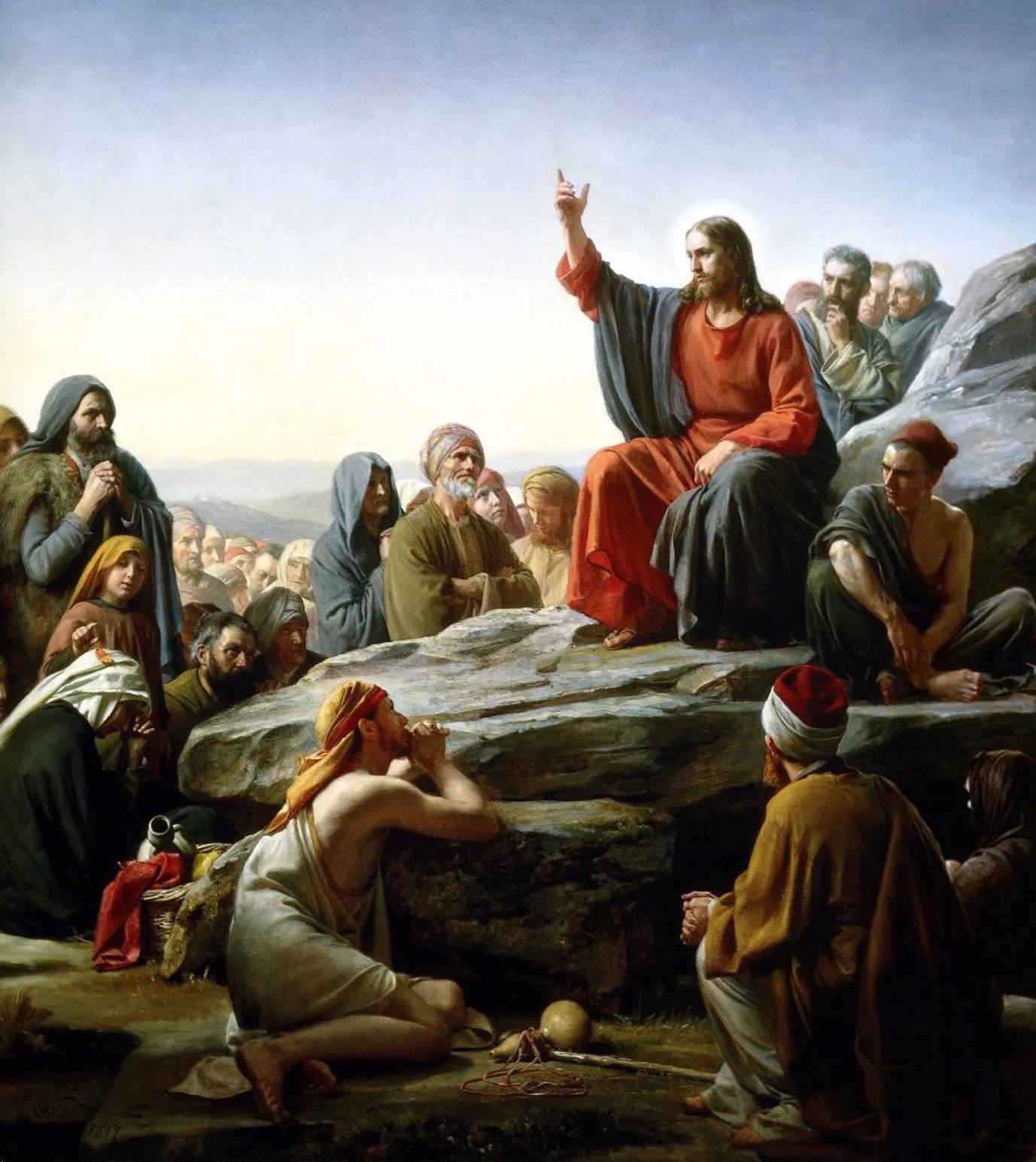
Now, in the Gospel, Our Lord gives a more practical illustration about those who portray themselves as pristine vessels entitled to the indwelling of God’s inspirations in their souls but in reality are soiled, depraved, and spiritually despicable. What makes matters worse is that these very same people are those who love, more than anything else, to exhibit such perceptions of worthiness to God that they end up forgetting how they have been broken by their own spiritual, moral, and temporal deficits. Jesus describes them aptly: false prophets dressed as sheep’s clothing, as though they could forever hide from accountability while playing the role of benevolence and virtue. In this, He provides us with a determiner: A good tree cannot bear bad fruit, nor can a bad tree bear good fruit. Anyone can claim to be a Christian but be callous enough to slack off in his or her responsibilities to cultivate an edified spiritual life and be a hypocrite instead. As much as God is the ultimate good, He cannot be mocked by implying that He can forgo rightful judgment just because of His all-encompassing mercy. The Prophet Jeremiah impeccably sums this up: I am the Lord who search the heart and prove the reins: who give to every one according to his way, and according to the fruit of his devices. (Jeremiah 17:10)
We should be nothing more or less than God’s children; therefore, let us rid ourselves of the trappings of guile. We must be the salt of the earth and the light of the world, and we shall never fulfill being such if we merely seek privilege and adulation through adorning ourselves with multiple masks.
THE RULE OF ST. BENEDICT: Prologue (par. 5-7)
What, most dear brethren, could be more sweet to us than this voice of the Lord inviting us? Behold the Lord points out the way of life to us by His own fatherly affection.
Let our loins then be girt with faith and the observance of good works, and let us, gospel led, pursue His paths, that we may be worthy to see Him Who has called us unto His own kingdom.
But if our wish be to have a dwelling-place in His kingdom, let us remember it can by no means be attained unless one run thither by good deeds. For, with the prophet, let us ask the Lord, saying to Him: “Lord, who will dwell in Thy tabernacle, and who will rest in Thy holy mount?” After putting this question, brethren, let us listen to our Lord showing us in answer the way to that same tabernacle by saying: “He who lives blamelessly and does justice; he who speaks truth from his heart; he who has kept his tongue from guile; he who has done his neighbour no evil and has accepted no slander against his neighbour”: he who has brought to naught the malignant slanderer the devil, rejecting from his heart’s thoughts him and his efforts to persuade him; and who has taken hold of his suggestions or ever they be come to maturity and has dashed them against the Rock which is Christ. Those who fear the Lord are not puffed up by their own good observance of rule, but reckoning that the good that is in them could not be wrought by themselves but by God, magnify the Lord working in them and say with the prophet: “Not unto us, O Lord, not unto us, but to Thy Name give glory.” Just as also the Apostle Paul attributed nothing to himself concerning his own preaching, but said: “By the grace of God, I am what I am.” And again the same Paul said: “He who glories, in the Lord let him glory.”
***
Reflection:
It is grace that works in us, lest anyone should boast: to paraphrase St. Paul, we are exhorted to only keep our hearts to those that are above; and to do so, is the humble acknowledgment in ourselves that apart from Our Lord, we can do nothing. Indeed: our godly works would only be for naught, if our hearts are not predisposed to Him Who bequeathed unto us our soul. Hence, as Christians, we ought to keep it into ourselves that in Him we live and move and have our being; we are nothing without Him as it is only through Him that we are, and that our personal triumphs are not ours but His.
6th Sunday After Pentecost: Our Lord Sustains Us
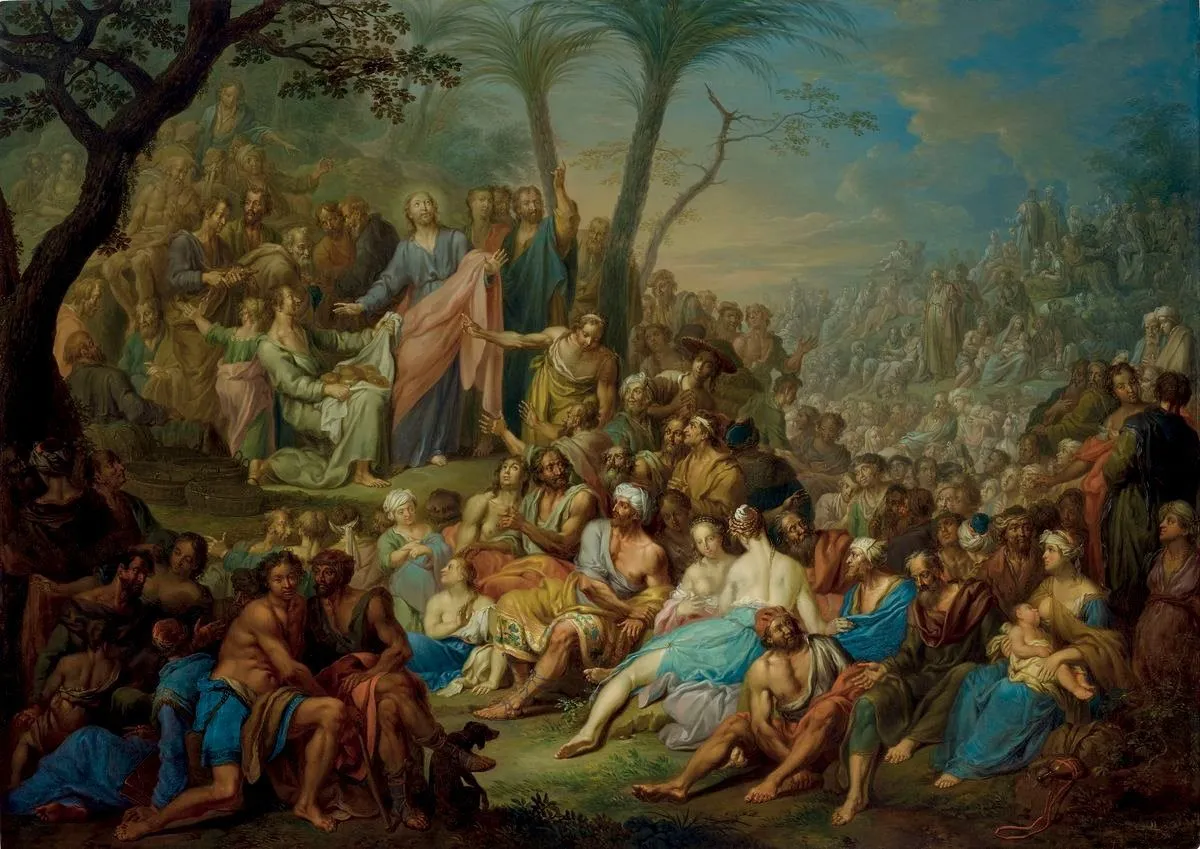
For the Gospel on this sixth Sunday after Pentecost, Our Lord feeds the hungry multitude who have come to Him to hear the Gospel. Hundreds—even thousands—of people gathered to hearken unto Jesus speak of the Kingdom of Heaven: men, women and their children, and perhaps even those whose curiosities could not keep them from beholding the Christ from afar. Some could even have been doubters who merely take this as an opportunity to filter out supposed contradictions to an otherwise consistent message of salvation and truth. Yet, whatever their states of life may be, they were all there—a massive crowd, with various experiences, problems, concerns, situations.
The God-Man, in His human and Divine nature, understood full well that despite He, as the Bread from Heaven, the Nourisher of souls, should also give way to the inclinations and needs of mortal men; thus, He asks whether the crowd may be able to eat, thence satiating their need for sustenance that have been wanting for three days. The marketplace is far off: each of these should trudge by foot all the way into the cities just so they could have their fill of food and drink. It poses such an inconvenience indeed, especially with little ones in tow; then, as they return for the culmination of Our Lord’s preaching, it would belabour them anew. At this, Jesus had willed in Himself to make the people rest: food shall be provided, God shall work a miracle today.
In retrospect (and if we should place ourselves in the shoes of the gathered assembly), it might have seemed normal to us to have food served freely, as is conceivably due. We could have plainly taken our food, given thanks for the hearty meal, and gone along our way without thinking twice as to where it came from. Moreover, we would have never suspected that a miracle had taken place, as the process through which it was undertaken was not divulged nor gossiped about. Our sustenance was as quiet and simple as something borne out of the ordinary; yet, unbeknownst to our most finite minds, the Lord has already nurtured both our bodies and our souls.
Isn’t it the Eucharist similar to this? Whenever we assist at Mass, all we behold in our presence is bread and wine in its physical accidents: nothing extraordinary seems to be taking place yet through Transubstantiation, matter becomes Our Lord’s true Body and Blood. As we then partake of this, we do not only receive the tangible but God Himself who loves us and wills us to be saved. Quietly, among the most inaudible parts of the Mass, Our Lord manifests Himself and dispenses His gentle care unto us—that through receiving Him, grace lifts our souls and makes us united unto Him.
Verily enough: as Christ Himself had said, “Man does not live by bread alone”, we are called to remember that our tangible nature is not the pinnacle of our existence. We were created to be sustained, not merely by mammon, but also God Himself. He is the water of life and He is the bread of heaven; and we, who sigh—poor children of Eve—hope and exist through His ineffable Love in the Eucharist.
In the Mass, the testimony of God’s Love, we find our solace and rest.
The Healing Power of God through Sacramentals
(N.B.: This was originally posted on my Facebook wall; but I decided to repost it here in my blog in order to encourage more of my fellow Catholics to take advantage of the gifts that the Church bequeaths upon the faithful as conduits of grace emanating from God and the sacraments He established.)
Recently, I have been sick. My flu symptoms became really evident last week (I think that was a Monday or a Tuesday) where my sore throat was getting worse and I began sneezing so bad. I tried taking turmeric tea twice a day; although it alleviated a burgeoning discomfort in my trachea, still the throat area was aching profusely. I was in the thick of my work and some chores so I never paid things much attention, so when Thursday came, I felt sick to my core. The tea was not working and although I had already been considering preparing a saline solution for my throat, I’ve always never responded perfectly to it ever since before so I usually resorted to cough syrups and other over the counter medications instead like Bactidol. Yet, I could not go out to purchase anything from the drugstore since I was not feeling that well anymore so I merely went on with a salt gargle.
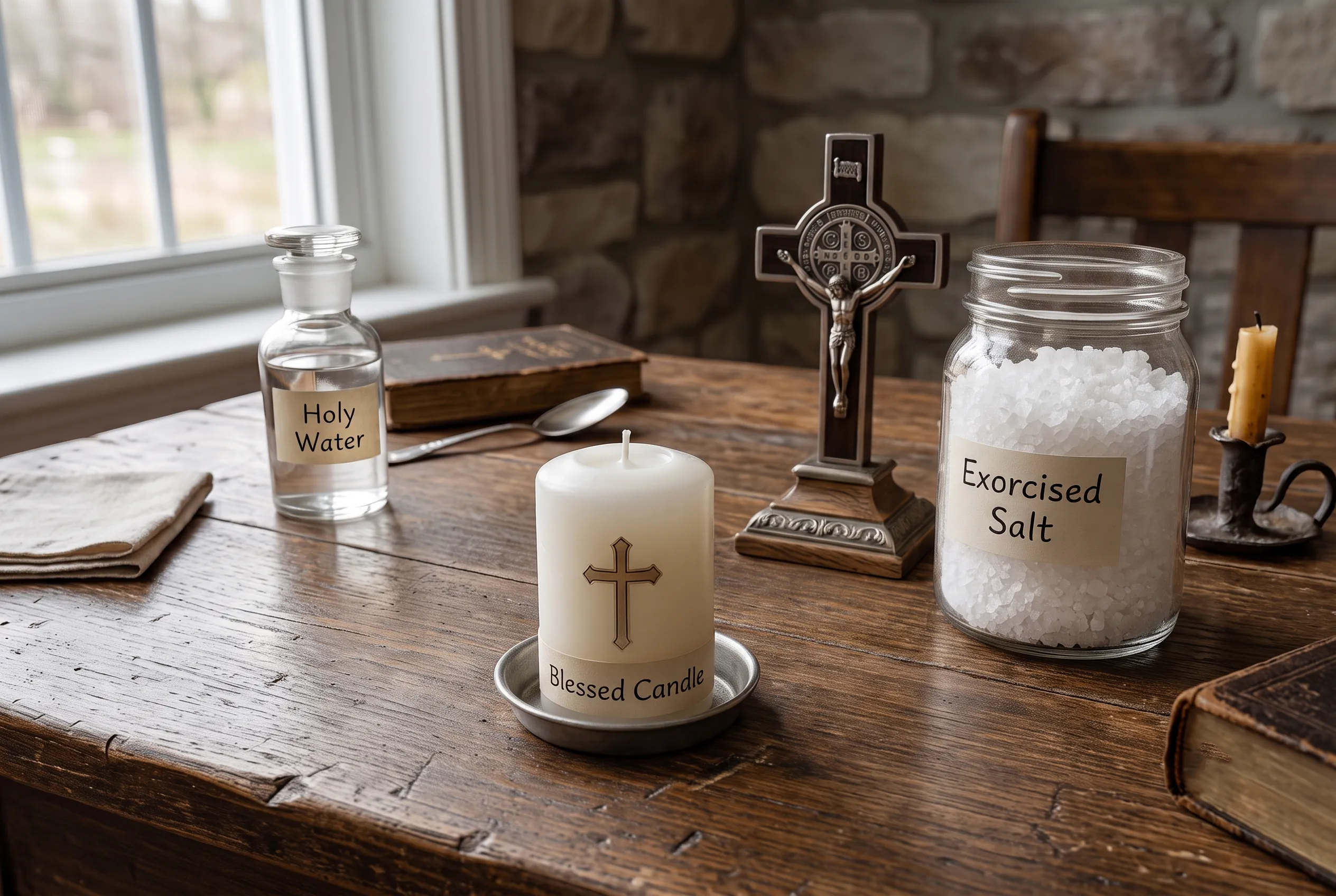
One thing would be unique with the salt preparation though: I used exorcised salt instead of just regular salt. I was also still a little sceptical if it would work because of my previous experiences with salt gargles, except that those were just “regular” salt, i.e., without the blessings of the Church. “Lord, I just hope this works,” is what I thought I muttered at that time.
After the procedure, the result was almost instantaneous based on how I observed it: phlegm began to be mixed with the gargle which was something that I never experienced before. It really astounded me and kept telling myself, “this is weird.” I finished up the entire mug then went to bed.
The next day, I began coughing up a lot of those stubborn sticky phlegm as if I was taking antibiotics (and all I was preoccupied with were my prayers, consuming some exorcised salt grains before bedtime, turmeric tea, Biogesic, my usual hot or warm water). Yes, the cough and colds were really intense but I did not experience having my nose stuffed as if I’d have an asthma attack (a far cry from my usual experiences ever since childhood). The coughing itself was almost like persecution as well; however, despite no antibiotics, it was as if my lungs were being cleared slowly but surely. Fever was also present but it would subside quickly. Also, my SO began praying a chaplet to St Lazarus for my health since Saturday.
Today I feel more relieved. Yes, the cough and colds are still here but I can function a bit better now unlike last week.
This, I daresay, is evidence of how God uses ordinary objects, i.e., sacramentals, like blessed or exorcised salt to impart His healing power (and I speak about this as a person who has always been a natural sceptic). Those are not trivial superstitions nor charms, unlike what our Protestant brethren or many unbelievers would make everyone believe. Such objects, when consecrated to God for a noble and blessed purpose impart both physical and spiritual graces, 𝑒𝑥 𝑜𝑝𝑒𝑟𝑒 𝑜𝑝𝑒𝑟𝑎𝑛𝑡𝑖𝑠 or 𝑒𝑥 𝑜𝑝𝑒𝑟𝑒 𝑜𝑝𝑒𝑟𝑎𝑛𝑡𝑖𝑠 𝐸𝑐𝑐𝑙𝑒𝑠𝑖𝑎𝑒, aligned with the natural course of things, as a testament to how God’s omnipotence transcends time and space to reach out to us though how lowly we may all be.
In this regard, I leave everyone an excerpt from the Catechism of the Catholic Church on this subject (par. 1668-1670):
The characteristics of sacramentals
1668 Sacramentals are instituted for the sanctification of certain ministries of the Church, certain states of life, a great variety of circumstances in Christian life, and the use of many things helpful to man. In accordance with bishops’ pastoral decisions, they can also respond to the needs, culture, and special history of the Christian people of a particular region or time. They always include a prayer, often accompanied by a specific sign, such as the laying on of hands, the sign of the cross, or the sprinkling of holy water (which recalls Baptism).
1669 Sacramentals derive from the baptismal priesthood: every baptized person is called to be a “blessing,” and to bless. Hence lay people may preside at certain blessings; the more a blessing concerns ecclesial and sacramental life, the more is its administration reserved to the ordained ministry (bishops, priests, or deacons).
1670 Sacramentals do not confer the grace of the Holy Spirit in the way that the sacraments do, but by the Church’s prayer, they prepare us to receive grace and dispose us to cooperate with it. “For well-disposed members of the faithful, the liturgy of the sacraments and sacramentals sanctifies almost every event of their lives with the divine grace which flows from the Paschal mystery of the Passion, Death, and Resurrection of Christ. From this source all sacraments and sacramentals draw their power. There is scarcely any proper use of material things which cannot be thus directed toward the sanctification of men and the praise of God.”
That in all things, God may be glorified.
THE RULE OF ST. BENEDICT: Prologue (par 1-4)
Translated by: Rev. Boniface Verheyen (1844-1923)
NOTE: I have thought of posting excerpts every two days at the least of the Rule of St. Benedict as a way of starting 2025 right, as a means to uplift the spiritual life. I shall also be writing some reflections about the Rule every now and then that shall feature my insights about St. Benedict’s teachings. May God bless us all.
/////
Listen, O my son, to the precepts of thy master, and incline the ear of thy heart, and cheerfully receive and faithfully execute the admonitions of thy loving Father, that by the toil of obedience thou mayest return to Him from whom by the sloth of disobedience thou hast gone away.
To thee, therefore, my speech is now directed, who, giving up thine own will, takest up the strong and most excellent arms of obedience, to do battle for Christ the Lord, the true King.
In the first place, beg of Him by most earnest prayer, that He perfect whatever good thou dost begin, in order that He who hath been pleased to count us in the number of His children, need never be grieved at our evil deeds. For we ought at all times so to serve Him with the good things which He hath given us, that He may not, like an angry father, disinherit his children, nor, like a dread lord, enraged at our evil deeds, hand us over to everlasting punishment as most wicked servants, who would not follow Him to glory.
Let us then rise at length, since the Scripture arouseth us, saying: “It is now the hour for us to rise from sleep” (Rom 13:11); and having opened our eyes to the deifying light, let us hear with awestruck ears what the divine voice, crying out daily, doth admonish us, saying: “Today, if you shall hear his voice, harden not your hearts” (Ps 94[95]:8). And again: “He that hath ears to hear let him hear what the Spirit saith to the churches” (Rev 2:7). And what doth He say?—”Come, children, hearken unto me, I will teach you the fear of the Lord” (Ps 33[34]:12). “Run whilst you have the light of life, that the darkness of death overtake you not” (Jn 12:35).